

Topics
- Jewish American Heritage
- Jewish History
Summary
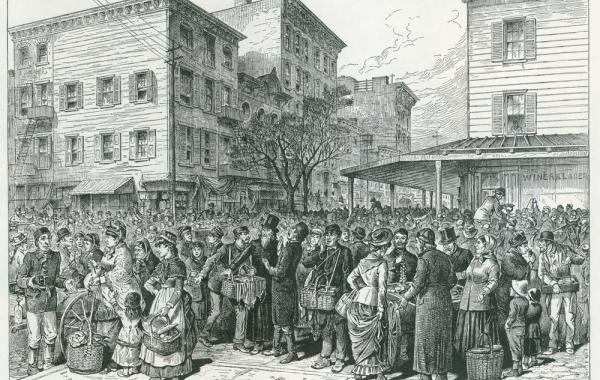
Jews have settled in North America since the 1600s, seeking safety and opportunity. Though diverse in background, they shared a desire for freedom, an ideal central to both America’s promise and its contradictions. Between 1880 and 1924, over 2 million Jews fled violence, poverty, and persecution to join a massive wave of global immigration to the United States. That movement was sharply limited by the Johnson-Reed Act of 1924, which restricted Jewish immigration until reforms in 1965 reopened doors to Jews from the Soviet Union, Iran, and beyond.
In this lesson from the Weitzman National Museum of American Jewish History in partnership with Project Mosaics, students explore waves of Jewish immigration to the United States, from the late 19th and early 20th centuries to more recent arrivals from Cuba, the Soviet Union, and Iran. They will consider personal ties to immigration, examine push-pull factors, and analyze poems, testimonies, and cartoons. The lesson ends with students writing a “Beginner’s Guide to America,” inspired by an Iranian Jewish immigrant’s version.
More From Stories That Shaped A Nation


